In the novel, the author gives a macrocosm point of view in chapter 17 and a microcosm point of view in chapter 16. In chapter 17, the author addresses the unity of the migrant families in the camps. This point of view gives a general or big picture of what was life like for migrant families during the Great Depression and Dust Bowl. The author describes, "Twenty families became one family, the children were the children of all." (193) The idea of unity is emphasized because all the migrant families were like one big family. They all shared what they had with each other and treated each other as family. "The families learned what rights must be observed." (194) All the migrant families held basic beliefs and laws that they followed as a whole. Examples of the laws were simply to respect each other when sleeping and eating. Everyone treated each other with hospitality. They all held responsibilities as "children [went] to gather wood, to carry water; men [went] to pitch the tents.., women [cooked] the supper". (195) Every person in the camps knew that they were in charge of doing something in order to work together.
On the other hand, chapter 16 serves as the microcosm point of view. In the novel, this specific family is the Joad family. Chapter 16 also emphasizes the theme of unity, but in a more specific and focused way. In this chapter, the Joad family is continuing their travel to California. They meet another family called the Wilson family. The Joad and Wilson family travel together, helping each other in many ways. Before, when Grampa was about to die, the Wilsons let Grampa in their tent because he was sick. This was revisited in chapter 16 when Pa reminds the Wilson family that "Grampa died in [their] tent". (167) When the Wilson's car breaks down, the Joads offered to fix their car. The idea of helping each other is heavily emphasized in this chapter. Aside from working with each other, the theme of unity is also presented when Ma refuses to let Tom and Casey go fix the car themselves while the rest of the family moves on. When Tom first suggested idea, Ma immediately refused to let that happen. Ma stood strong and reaffirmed that "I ain't a-gonna go". (168) In the novel, Ma stands strong in her belief that the family must be united; additionally, this emphasizes the theme of unity just as in the intercalary chapter in chapter 16.
Overall, chapter 16 and 17 relate to each other in that they suggest the idea of unity. In chapter 16, this theme is focused specifically on the Joad family, while chapter 17 offers this theme for all the migrant families in general. In chapter 16, the Joads are united with each other and the Wilson family. In chapter 17, the author notes how migrant families united and worked with each other. Chapter 16 helps make sense of chapter 17 because it offers a focused point of view before offering a general point of view. In the same way, chapter 17 helps to make chapter 16 make sense because chapter 17 introduces how migrant families generally treated and helped each other during the Great Depression and Dust Bowl. This bigger picture helps the reader to understand the theme of unity. Overall, both chapter serves to stress the importance of helping each other.
Saturday, March 22, 2014

Monday, March 17, 2014
Chapter 16-19 (A)

The rule of that the hungry should be fed is crucial in the novel. The idea that one should help another is enforced because working together is the only way that they can live through harsh and difficult times.Without support from each other, an individual family will not be able to live through the long and dangerous journey to California. Thus, supplying each other for food at times when needed, will help everyone to be healthy and motivated. "A man with food fed a hungry man, and thus insured himself against hunger." (195) In other words, if one feeds another person when that person is in need of food, he or she will in return, receive help at times when he or she needs it. The theme of selflessness is crucial in the novel because without each others help, everyone will not be able to go on. In addition, supporting each other, results in happiness for everyone. Altogether, the rule of feeding the hungry is obligatory because it not only helps the person who is hungry, but in addition, it results in happiness in the society. Thus, one of the rules of society, is to feed the hungry. This rule contributes to the function of the camping societies because feeding each other in times of difficulties, help the society as a whole to continue to work and be motivated. However, not all people would want to share their food with others if the food is rich and good. Thus, another rule was established to avoid such conflicts.
The rule that it is unlawful to eat good rich food near one who is hungry, unless he is asked to share, may have contributed to the function of the camping societies because the idea of equality is vital in helping each other. Similar to the the rule that the hungry should be fed, people in the camps should help feed the hungry if they can afford to. However, some humans have the instinct of saving what they have for themselves, which results in selfishness. For instance, if one had an abundance supply of food, he or she should share it with the hungry because everyone in society should be equal. Ultimately, we know that in society, if one had plentiful amount food, he or she may have a tendency to want to keep it for him or her self. This is due to the idea of worrying about his or her own survival rather than caring about others in need of help. Thus, in the camping society, if one simply wants to eat rich food that he or she has, they must share it with others. If he or she does not desire to share it with others, then he or she should not eat it in front of them. In the novel, the author describes, "Those families which were very rich or very foolish with their money ate canned beans and canned peaches and packaged bread and bakery cake; but they secretly, in their tents, for it would not have been good to eat such fine things openly". (198) Here, the author notes that there are families who rather not share rich food simply because of the idea of helping themselves comes first. This rule was created to avoid the extent of how morally wrong it is to keep everything to yourself in public. Thus, those who kept rich food for themselves, were forbidden to show it in public unless they asked to share it with the hungry.
Chapters 11-15 (D)
In chapter 15, an instance of kindness towards others is shown. A worker named Mae shows her generosity towards a farmer when the farmer has little money to buy food. At first, she was a bit reluctant to sell the bread for a lower price, but in the end, she decided to help out the farmer. Furthermore, she sold two pieces of candy to the farmer for a penny. When the farmer asks Mae if the candy is worth a penny, Mae responds, "Oh-them. Well, no-them's two for a penny". (160) Her unselfishness to help out a farmer who is having obstacles in going to California, shows how kindness in helping others can lead society to help each other to live through harsh times. The idea of helping others is further proven to lead to good things when the truck drivers leave a big change to Mae in the end. The truck drivers saw how Mae had sold two pieces of candy for a penny, when the candy originally was supposed to cost five cents each. Thus, in return for helping the farmers who were in need, good karma came to Mae. These acts of kindness emphasize the idea of helping each other.
This quote impacted me because unselfishness can help everyone in society who is struggling, go through harsh and unhappy times. By helping each other, everyone can thrive in society. As Ralph Waldo Emerson once said, "The purpose of life is not to be happy. It is to be useful, to be honorable, to be compassionate, to have it make a difference that you have lived and lived well". Every person should have a duty in helping others. Helping another not only helps the person who got help, to be happy, but in addition, makes the person who helped, feel good in that he or she has made a difference in helping someone. In other words, helping one another rewards both sides since they get the reward of happiness knowing that they have helped each other.
Wednesday, March 12, 2014
Chapters 11-15 (B)
Highway 66
 |
| Picture Source |
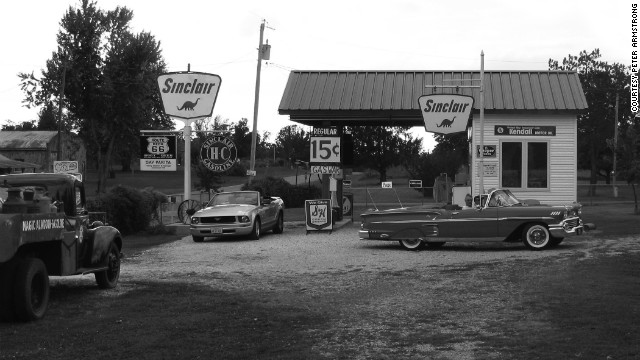
Route 66, or commonly known as the "mother road", is one of the most famous highways in the world. Stretching from Chicago to Los Angeles, the route is about 2,000 miles. Interestingly, the road is a two-lane road instead of a multi-lane road and passes by eight states. In the novel, the Joad family, along with an estimated of 400,000 other migrants, travel from Oklahoma to California to escape the Dust Bowl and Great Depression. (source) Route 66 was the "road of opportunity" because it gave the tenant families a chance to live a better life. (source)
Route 66 is significant to the Joads and all migrants because it was the path of hope and new beginning. The Joads and migrants hoped to move from Oklahoma to California to escape the adversity they encountered. They looked forward to the job opportunities in California. The hope and faith they had gave them the motivation to travel a vast distance with the scarcity of daily necessities, such as food and water. The Joads and other migrants were unaware of the trouble they will face when they arrive in California, only looking forward to all the positive things they have heard about the place.
 |
| Picture Source |
Friday, March 7, 2014
Chapters 1-10 (F) *
Theme: Blame
"We can't depend on it. The bank- the monster has to have profits all the time. It can't wait. It'll die. No, taxes go on. When the monster stops growing, it dies. It can't stay one side". (32)
"I don't give a damn if you don't make payments. We ain't got your paper. We turn that over to the finance company. They'll get after you, not us. We don't hold no paper." (65)
Throughout the novel, the theme of blame has been brought up. In chapter 5, when farmers still had hope that next year they could make profit, the landowners stated that they could not possibly go on. The landowners stated that the banks are in control and that without profit, the banks will die. Here, the landowners put blame on the banks. By holding the bank accountable, the landowners are able to get away with what they personally desire. The inhumanity displayed by the landowners suggests that their actions are based on their own selfish needs. Landowners are now using tractors instead of farmers because it saves them money. Thus, by using the bank as an excuse, the owners can get rid of farmers and use tractors instead. In chapter 7, the blame on the bank is again indicated when sneaky salespeople try to sell cars. The salespeople tell the farmers that the cars are expensive because of the bank. The salespeople trick farmers into thinking that the banks control the price so that farmers are unable to do anything about it. By blaming the banks, the salespeople also emphasize the idea of greed. The salespeople are taking advantage of tenant farmers for their own personal needs. Overall, throughout the novel, the banks are taken advantage of. By accusing the banks, the landowners and salespeople are able to manipulate the tenant farmers. The idea of being able to blame the bank is an essential theme in the novel.
"We can't depend on it. The bank- the monster has to have profits all the time. It can't wait. It'll die. No, taxes go on. When the monster stops growing, it dies. It can't stay one side". (32)
"I don't give a damn if you don't make payments. We ain't got your paper. We turn that over to the finance company. They'll get after you, not us. We don't hold no paper." (65)
Throughout the novel, the theme of blame has been brought up. In chapter 5, when farmers still had hope that next year they could make profit, the landowners stated that they could not possibly go on. The landowners stated that the banks are in control and that without profit, the banks will die. Here, the landowners put blame on the banks. By holding the bank accountable, the landowners are able to get away with what they personally desire. The inhumanity displayed by the landowners suggests that their actions are based on their own selfish needs. Landowners are now using tractors instead of farmers because it saves them money. Thus, by using the bank as an excuse, the owners can get rid of farmers and use tractors instead. In chapter 7, the blame on the bank is again indicated when sneaky salespeople try to sell cars. The salespeople tell the farmers that the cars are expensive because of the bank. The salespeople trick farmers into thinking that the banks control the price so that farmers are unable to do anything about it. By blaming the banks, the salespeople also emphasize the idea of greed. The salespeople are taking advantage of tenant farmers for their own personal needs. Overall, throughout the novel, the banks are taken advantage of. By accusing the banks, the landowners and salespeople are able to manipulate the tenant farmers. The idea of being able to blame the bank is an essential theme in the novel.
Thursday, March 6, 2014
Chapters 1-10 (C) *
Dear precious farmland,
My family and my ancestors have been everlastingly nurturing you. You have given us an abundance of resources in order for us to survive. We greatly appreciate the crops that you supply us with and we really feel fortunate. The connection between us is inexpressible as you have done so much for our family. We have been continuing to nurture you throughout these many decades, and will not give up.
However, we are currently facing danger. The "monster" has come to us and demand that we give up on your land. (33) They do not understand the love in what we farmers do for maintaining this beautiful land. We have a true passion for farming, but the banks do not understand,"they [only] breathe profits; they eat the interest of your money". (32) The bank told us to leave and tractors have replaced us farmers. Now, we are "half starved", "the kids are [always] hungry", and "we [have] no clothes". (33) I do not know how to accept this fact of having to leave you. "Grampa.. had to kill the Indians and drive them away" for you. (34) Furthermore, "Pa was born here, and he killed weeds and snakes". (33) We continued to stay here despite of the many obstacles.
We thought that perhaps we can do what Grampa and Pa did. Maybe we can "kill [the] banks or [monsters]", just as Grampa killed the Indians and Pa killed snakes for this land.(34) Despite the possibilities, the tenants said that "[we] have to go" because of the "monster". (34) The thought of this separation breaks our hearts. We wanted to let you know that even if we are forced to leave you, we will forever have this deep connection with you. We will try our best to stay.
Love,
Tom Joad
My family and my ancestors have been everlastingly nurturing you. You have given us an abundance of resources in order for us to survive. We greatly appreciate the crops that you supply us with and we really feel fortunate. The connection between us is inexpressible as you have done so much for our family. We have been continuing to nurture you throughout these many decades, and will not give up.
However, we are currently facing danger. The "monster" has come to us and demand that we give up on your land. (33) They do not understand the love in what we farmers do for maintaining this beautiful land. We have a true passion for farming, but the banks do not understand,"they [only] breathe profits; they eat the interest of your money". (32) The bank told us to leave and tractors have replaced us farmers. Now, we are "half starved", "the kids are [always] hungry", and "we [have] no clothes". (33) I do not know how to accept this fact of having to leave you. "Grampa.. had to kill the Indians and drive them away" for you. (34) Furthermore, "Pa was born here, and he killed weeds and snakes". (33) We continued to stay here despite of the many obstacles.
We thought that perhaps we can do what Grampa and Pa did. Maybe we can "kill [the] banks or [monsters]", just as Grampa killed the Indians and Pa killed snakes for this land.(34) Despite the possibilities, the tenants said that "[we] have to go" because of the "monster". (34) The thought of this separation breaks our hearts. We wanted to let you know that even if we are forced to leave you, we will forever have this deep connection with you. We will try our best to stay.
Love,
Tom Joad
Wednesday, March 5, 2014
Chapters 1-10 (G)
Man v. Machine
In the novel, there is a reoccurring conflict between man and machine. The tractor was a newly invented machine that could work more efficiently in terms of time. It worked much quicker than what farmers could do. There is a significant conflict with this because tractors are replacing farmers. This affects the farmers because they are in danger of losing their jobs. The owner states that "One man on the tractor can take place of twelve of fourteen families."(33) Using tractors can help landowners save money which ultimately leads farmers to a downfall. Without money for food or daily necessities, farmers are not able to support their families. Tractors are harming farmers and the meaning of having a passion for farming. The author states that "[tractors] rape without passion". (36) The machines do not have the connection as farmers have with farming. The tractors just get the job done while farmers "lusted [the seed] for growth". (36) The machines are ruining the passion that man has for farming. Because of tractors, "crop land isn't for [farmers] any more". (37) The driver tells the tenant farmers that they need to earn money "someplace [else]". (37) Essentially, the machine is going to ruin all the farmer's jobs. This is a major conflict throughout the novel because farmers have to move to California because of this.
Subscribe to:
Comments (Atom)